
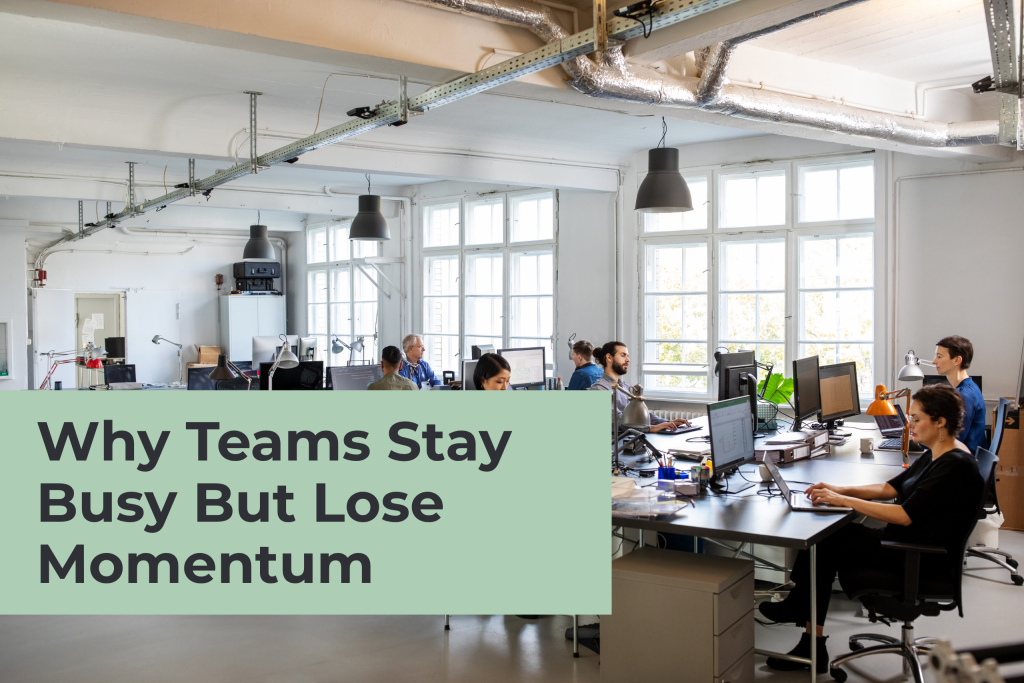
A lot of teams are moving constantly without actually progressing.
Calendars are full.
Messages are nonstop.
Meetings happen back-to-back.
Everyone is busy.
And yet work still feels strangely heavy.
This is one of the most common patterns showing up across modern organisations.
Not a lack of effort.
A lack of momentum.
And the two are not the same thing.
Activity Is Not The Same As Progress
Most teams assume that if people are:
- responsive
- hardworking
- collaborative
- constantly active
…then progress should naturally follow.
But activity and momentum are very different things.
A team can be highly active while still losing traction underneath the surface.
This often happens when work becomes overly coordination-heavy.
People spend increasing amounts of time:
- clarifying priorities
- revisiting decisions
- attending update meetings
- responding to shifting requests
- managing fragmented communication
The work around the work starts consuming the work itself.
What Is Coordination Overload?
Coordination overload happens when teams spend more time managing work than progressing it.
It often shows up through:
- repeated conversations
- duplicated communication
- excessive meetings
- unclear ownership
- fragmented priorities
- constant context-switching
This creates operational drag.
And over time, operational drag becomes exhausting.
Because no matter how much effort goes in, the output no longer feels proportionate.
Why Momentum Weakens
Momentum weakens when priorities fail to hold.
A decision gets made on Monday.
Reopened on Wednesday.
Reinterpreted on Friday.
So teams stop progressing confidently.
Instead, they stay reactive.
People become hesitant to move too quickly because they assume priorities may shift again shortly afterwards.
This is one of the hidden behavioural consequences of organisational friction.
Over time:
- ownership becomes diluted
- accountability weakens
- execution slows
- confidence drops
- teams lose their sense of progress
Not because people do not care.
Because the system keeps interrupting movement.
Why Responsiveness Can Become A Trap
A lot of organisations unintentionally reward responsiveness more than clarity.
Fast replies become valued.
Constant availability becomes normalised.
Meetings multiply in the name of collaboration.
But underneath it, focused execution weakens.
In many organisations, coordination is quietly replacing momentum.
And teams start mistaking motion for progress.
What Better Teams Do Differently
High-performing teams are not necessarily the busiest.
But they are usually clearer.
They:
- reduce unnecessary coordination
- protect focus
- keep priorities stable
- reinforce ownership consistently
- make decisions stick for longer
Because momentum does not come from doing more work.
It comes from reducing the friction interrupting the work that matters most.
Frequently Asked Questions
Why are teams busy but not productive?
Teams often lose productivity when coordination, meetings and shifting priorities consume too much time and attention.
What causes coordination overload?
Coordination overload is usually caused by unclear ownership, fragmented communication, excessive meetings and unstable priorities.
Why do priorities constantly shift in organisations?
Priorities often shift when alignment is weak, ownership is unclear and decision-making lacks consistency.
What is operational drag?
Operational drag is the hidden friction slowing progress through excessive coordination, unclear systems and repeated interruptions.